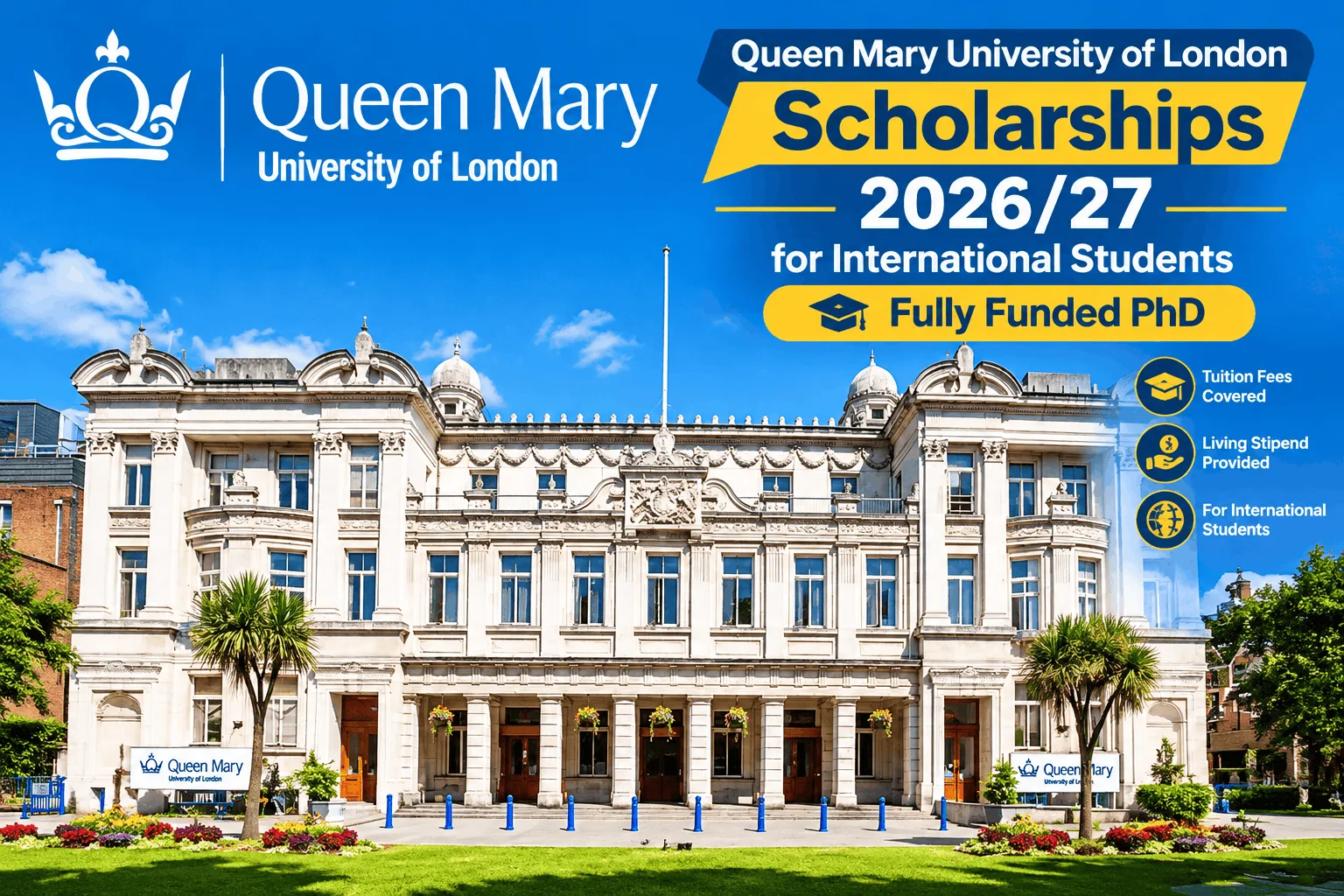
Queen Mary University of London Scholarships 2026/27: What International Students Can Really Get
- Country
- UK
- Level
- Undergraduate, Masters, PhD
Queen Mary University of London (QMUL) is a respected Russell Group university, and it offers a wide range of scholarships, but the honest picture for international students is more nuanced than "fully funded." For undergraduate and taught master's study, QMUL's awards are mostly partial tuition reductions; the genuinely fully funded route is a PhD studentship. Knowing which is which, and budgeting for expensive London, is what turns a QMUL plan from hopeful into realistic. This guide lays it out clearly.
The honest split: partial for taught degrees, full for PhDs
Here is the distinction that matters most. QMUL's scholarships fall into two very different groups:
- Taught-degree scholarships (undergraduate and master's) are mostly partial tuition reductions, commonly a few thousand pounds up to around 10,000 pounds, including newer awards such as the Postgraduate Global Excellence Scholarship and various President's, school, and country-specific awards.
- PhD studentships are the genuinely fully funded route, competitively awarded research funding that typically covers tuition fees plus an annual living stipend for three or more years.
So if you are applying for a bachelor's or a taught master's, expect partial support and plan to cover the rest. If you want full funding, a funded PhD studentship is the path, and it works like a research application rather than a tick-box scholarship.
What the taught-degree scholarships are really worth
For undergraduate and taught master's applicants, QMUL's international scholarships typically reduce tuition by a meaningful but partial amount. They are worth having, a few thousand pounds up to roughly 10,000 pounds off, but they do not cover living costs, and London living costs are high. The scholarships change each year and differ by school, so the single most useful thing you can do is check the funding page for your specific programme and QMUL's scholarship database, rather than relying on a generic figure. Some awards are automatic on admission; others need a short separate application with its own deadline, and many prevent you from holding more than one award at once.
A concrete example is the kind of faculty award QMUL has offered to international master's students, for instance in the Faculty of Science and Engineering: typically worth around £2,000 to £3,000 (sometimes framed as a grant of up to £3,000 toward first-year study, or about £2,000 off tuition), open to applicants of all nationalities who pay overseas fees. Key conditions usually attached to these awards:
- You must hold the equivalent of a UK first-class bachelor's degree (or overseas equivalent) for the master's programme.
- You cannot already hold another university scholarship or a full-fee award from elsewhere.
- Part-time students receive the award split 50 percent in year one and 50 percent in year two.
- They are often automatic on admission (no separate scholarship form), with eligible applicants considered once they apply through QMUL's MySIS applicant portal, though some carry their own deadline (recent faculty awards have closed around early autumn).
Treat this as illustrative of the scale and conditions rather than a guarantee for your exact programme: confirm the specific award, amount, and deadline for your course on QMUL's official pages. Our scholarships listings can help you line up fuller options alongside it.
A worked budget: studying in London
Because taught-degree awards are partial, the real numbers matter, and London is one of Europe's most expensive cities. Here is the honest monthly shape for a single international student:
- Rent: your largest cost by far, with London rents high and student or shared housing the realistic option.
- Food, transport, and essentials: manageable with student discounts and cooking at home, but still significant.
- Overall: a single student typically needs roughly 1,400 to 1,900 pounds per month to live in London.
On top of living costs, you pay the remaining tuition after a partial scholarship. The UK student visa also requires proof of maintenance funds, set higher for London, so you must show you can cover living costs regardless. Budget for the full picture, partial scholarship applied, tuition balance, plus London living, before you commit.
The fully funded route: PhD studentships
If full funding is essential, focus on a QMUL PhD studentship. These competitive awards typically cover tuition plus an annual stipend (often at the standard UK research rate) for the duration of the doctorate. They are research-based, so success depends on a strong research proposal and, usually, a supervisor and project fit, much like a research job application. Studentships often have fixed, early deadlines and are advertised by school or research group, so if you are heading toward a PhD, search QMUL's studentship listings in your field, contact potential supervisors, and apply to specific funded projects. This is a completely different, and genuinely fully funded, path from the partial taught-degree scholarships.
Who is eligible
- Overseas fee-paying international students admitted to a QMUL programme.
- Applicants meeting the academic-merit criteria of each specific award.
- For PhD studentships, applicants with a strong research background and a project or supervisor fit.
- Applicants who follow each award's own application process and deadline, since these vary.
How to apply, step by step
- Choose your QMUL programme and find its specific funding page.
- Check QMUL's scholarship database for the awards you are eligible for, and note which are automatic versus separate-application.
- Apply for admission, and complete any separate scholarship application before its deadline.
- For a PhD, target funded studentships, contacting supervisors and applying to specific projects.
- Plan your budget for the tuition balance plus London living, and prepare visa maintenance funds.
How to find the right QMUL scholarship for you
QMUL's scholarship landscape is large and changes each year, so the skill is matching yourself to the right awards rather than hoping a generic one applies:
- Start with your programme's funding page, since many awards are school or subject-specific.
- Search QMUL's scholarship database and filter by your level, nationality, and subject.
- Check country-specific awards, as QMUL and external sponsors sometimes fund students from particular countries.
- Note which awards are automatic versus separate-application, and diarise any separate deadlines.
- For research, search studentships by school and supervisor, since that is the fully funded route.
Spending an hour mapping the awards you are genuinely eligible for, and their separate deadlines, is far more productive than a vague search, because it is specificity, the right award for your exact profile, that turns into funding.
A realistic timeline
- Several months before the course: choose your programme, map eligible scholarships, and note each deadline.
- At application time: apply for admission and complete any separate scholarship applications early.
- For a PhD: contact supervisors and apply to funded studentships, which often close early.
- On an offer: compare your award against the tuition balance plus London living costs.
- Before enrolling: arrange your visa, including proof of maintenance funds set higher for London.
Common mistakes to avoid
- Expecting a full ride for a taught degree. Those awards are partial; PhD studentships are the full route.
- Relying on a generic figure. Scholarships and amounts vary by school and year, so check your programme.
- Missing a separate deadline. Some awards need their own application ahead of the course start.
- Underestimating London costs. Budget 1,400 to 1,900 pounds a month, plus the tuition balance.
- Overlooking the no-double-award rule. Many QMUL scholarships cannot be combined, so plan accordingly.
How QMUL compares to other UK funding
If a partial QMUL award does not close your gap, see it in context. Other UK universities offer similar partial international scholarships, so compare them. For full funding, the strongest UK routes for international students are PhD studentships (at QMUL or elsewhere), Chevening (fully funded UK master's for future leaders from many countries), and Commonwealth Scholarships (for eligible Commonwealth countries). If you need everything covered for a master's, Chevening or a Commonwealth award is a better target than a partial university scholarship, while QMUL studentships are the full route at doctoral level.
Is this right for you?
QMUL suits you if you are a strong international student who wants a respected London university and can cover the gap after a partial taught-degree scholarship, or if you are a research candidate who can compete for a funded PhD studentship. It is less suited to someone who needs a taught degree fully funded with no out-of-pocket cost, for whom Chevening, a Commonwealth Scholarship, or a PhD studentship is the better route. Matching your expectations to the right award, and budgeting for London, is what makes a QMUL plan work.
After graduation
A QMUL degree is well regarded internationally, and its London location puts you in one of the world's major hubs for finance, law, medicine, technology, and the creative industries, with strong internship and career opportunities. The UK's Graduate Route currently allows eligible international graduates to stay and work for a period after their degree, subject to current immigration rules, so a QMUL qualification can be a strong launchpad for a career in the UK or internationally. Being in London itself is a practical advantage throughout your studies, since the city's employers, professional networks, and internship opportunities are on your doorstep, and a strong QMUL degree combined with that access is what many graduates convert into their first role during the post-study work period.
Apply and confirm the details
Check the current scholarships, amounts, eligibility, and deadlines, and apply, on the official Queen Mary University of London pages: Queen Mary University of London scholarships, official site.
Explore more opportunities: browse all our scholarships, prepare for admission with our free IELTS and English prep, or learn how we verify every opportunity.
Disclaimer: OurScholarships is an independent information platform and is not affiliated with or endorsed by Queen Mary University of London. Scholarships and amounts vary by school and change each year, so always confirm on the official source before applying.
Frequently asked questions
Are Queen Mary scholarships fully funded?
Mostly not for taught degrees. For undergraduate and taught master's study, Queen Mary University of London (QMUL) offers a range of partial tuition scholarships, commonly worth a few thousand pounds up to around 10,000 pounds, plus newer awards like the Postgraduate Global Excellence Scholarship. The genuinely fully funded route at QMUL is a funded PhD studentship (covering fees plus a stipend), which is a different, research-based path. So read taught-degree awards as partial and PhD studentships as the full-funding option.
What scholarships are available for international students?
QMUL has many, varying by year and school, including the Postgraduate Global Excellence Scholarship, President's and school-specific awards, and country or subject-specific scholarships, typically partial tuition reductions. For research students, competitively awarded PhD studentships can be fully funded. Because the exact scholarships and amounts change each cycle and differ by school, check your specific programme's funding page rather than a generic figure.
Who is eligible and do I apply separately?
Most QMUL international scholarships are for overseas fee-paying students admitted to a QMUL programme, often with academic-merit criteria. Some are automatic on admission, while others require a short separate application, and many bar you from holding more than one award. Because the process differs by scholarship, read the rules for each award you are eligible for on QMUL's scholarship database, and note any separate deadlines.
What is the deadline?
Deadlines vary by scholarship and school, and some fall well before the course start, so there is no single QMUL date. Taught-degree scholarships and PhD studentships run on different timelines, and studentships in particular often have fixed, early deadlines. Always confirm the exact deadline for each specific award on the official QMUL pages, and apply early.
How much do I need to live in London?
London is expensive. A single student typically needs roughly 1,400 to 1,900 pounds per month for rent, food, transport, and personal costs, with rent the dominant expense. Because most QMUL taught-degree scholarships are partial, budget for the remaining tuition plus London living costs, and remember the UK student visa requires proof of maintenance funds, which are set higher for London.
What is the genuinely fully funded option at QMUL?
A funded PhD studentship. These competitive, research-based awards typically cover tuition fees plus an annual stipend for living costs (often at the standard UK research rate), for three or more years. If you need full funding at QMUL, a PhD studentship is the route, whereas undergraduate and taught master's scholarships are partial tuition support rather than full packages.